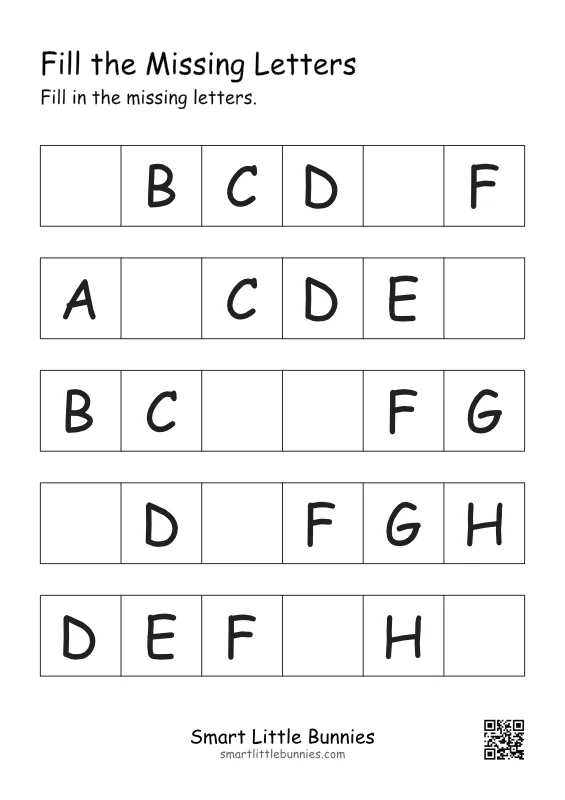
"Fill the missing letters" is a different kind of alphabet practice from tracing. Instead of forming letters, the child has to reason about where each one sits in the sequence, which letter comes before, which comes after, what is missing in the gap. It is a quiet, logical task rather than a motor one, and it tends to suit children who have learned their letters but are still shaky on the order of the alphabet.
This is a free set of seven lowercase worksheets that build from easy to challenging. Early sheets stay in the first half of the alphabet with two gaps per row; later sheets cover the full a–z with more gaps and trickier spacing. You can move through them as a ladder, or jump to the level that matches where your child is.
Why Sequencing Practice Helps
Knowing letters and knowing their order are two separate skills. A child can recognise every letter on a flashcard and still hesitate over what comes after "p." Sequencing worksheets target that gap directly. To fill a blank, the child finds a known "anchor" letter nearby and counts forward or back, which builds working memory and the mental number-line-for-letters that later helps with dictionary use, spelling, and alphabetising.
The thing to encourage is reasoning, not guessing. When a child is stuck, the useful prompt is "what letter do you know in this row, and what comes right after it?" rather than just giving the answer. Saying the alphabet quietly while pointing along the row is the strategy that does the work.
How to Use These Worksheets
- Print on A4 or US Letter paper.
- Use pencils so children can erase and self-correct.
- Have your child find a letter they know first, then count forward to the blank.
- Encourage them to scan the whole row before writing anything.
- Review together afterward and ask how they worked out each missing letter. The explanation matters more than the answer.
The Worksheets
The set is grouped into three stages. Start at the stage that fits your child and move up as they get confident.
Stage 1 — First Half of the Alphabet (a–m)
Two gaps per row, letters limited to a–m, so beginners work within a familiar range. Worksheets 1 and 2 cover the same level with different blank positions, so the second sheet is good reinforcement without raising the difficulty.
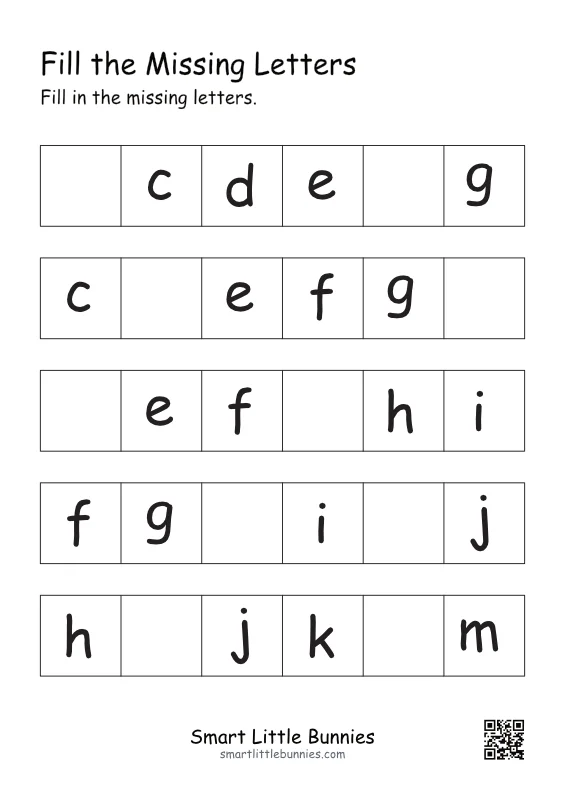
Worksheet 1 — a–m, two missing letters per row, gentle introduction.
Worksheet 2 — a–m, two missing letters, varied blank positions for extra practice at the same level.
Stage 2 — Later Letters (n–z)
The back half of the alphabet gets less practice, so children are often weaker here. These two sheets focus on n–z with two gaps per row, evening out alphabet knowledge.
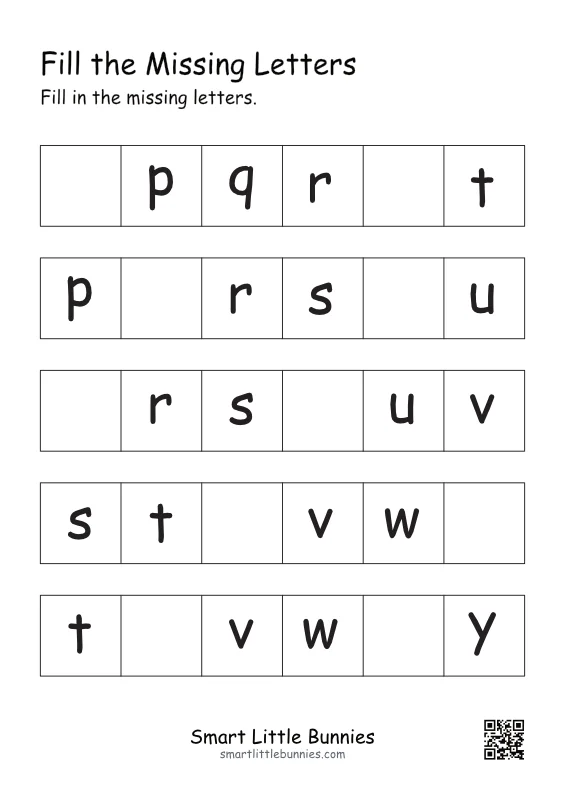
Worksheet 3 — n–z, two missing letters, mixed gap positions.
Worksheet 4 — n–z, two missing letters, different blank patterns for reinforcement.
Stage 3 — Full Alphabet & Review (a–z)
Once both halves are solid, these sheets mix the whole alphabet and add a third gap per row, so children rely on true alphabet knowledge rather than a memorised stretch.
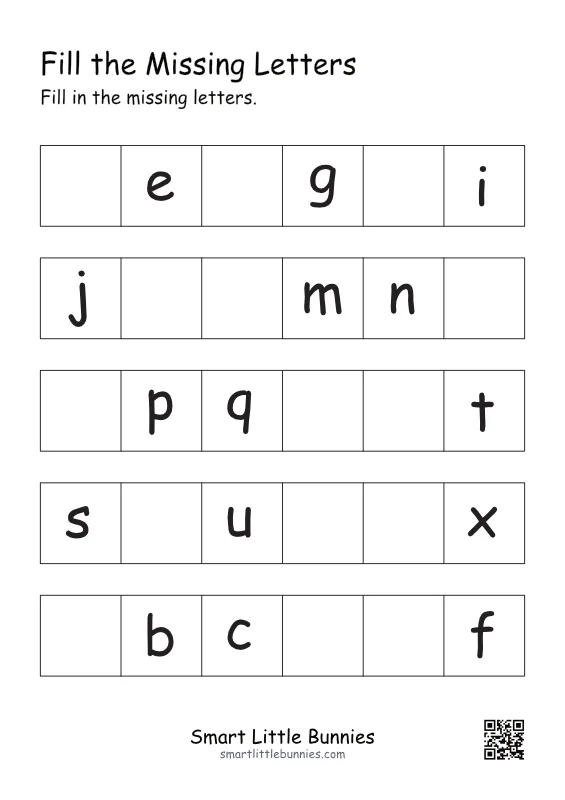
Worksheet 5 — full a–z, three missing letters per row, mixed ranges.
Worksheet 6 — full a–z, three missing letters with some adjacent gaps, the hardest sheet. Adjacent blanks mean the child cannot lean on a neighbouring letter and has to hold more of the sequence in mind.
Worksheet 7 — full a–z review, a mix of two and three gaps in highly varied positions. Works well as a recap or an informal check of how confidently your child knows the order.
What Children Build From This Set
- lowercase letter recognition
- alphabet order across the full a–z, not just memorised chunks
- logical reasoning and the "find an anchor, count forward" strategy
- working memory, holding several positions in mind at once
- visual scanning and attention to detail
- fine-motor control through writing the letters
A calm, screen-free activity that grows with your child, from first sequencing attempts in preschool to confident full-alphabet review in the early primary years.