Shape matching is one of the first activities where children connect an abstract idea, a shape, to the real things around them. A circle stops being just a line on a page and becomes a ball, a clock, a wheel. That jump from symbol to real object is the foundation of early geometry, and drawing-a-line matching is a low-pressure way to practice it.
This is a free set of five shape matching worksheets. Each page asks children to draw a line from a shape to the everyday object that matches it. The set moves from the four basic shapes through to more varied objects, so you can start simple and build up as your child gets confident.
Why Shape Matching Helps More Than It Looks Like
On the surface it is just drawing lines. Underneath, a few things are happening at once. The child has to recognise the shape, hold its outline in mind, scan a set of objects, and find the one whose form matches. That is shape recognition, visual scanning, and the beginning of spatial reasoning, all in one small task. The line-drawing itself is fine-motor and hand-eye practice.
The most common stumble is matching by colour or theme instead of shape, a child connects the round ball to the round clock visually but then pairs the square window with the round plate because both are "kitchen things." Gently steering them back to "what shape is it?" is the whole point of the exercise, and it is worth doing out loud.
How to Use These Worksheets
- Print on A4 or US Letter paper, whichever fits your printer.
- Give your child a pencil or crayon to draw the connecting lines.
- Have them name each shape aloud as they match it, "circle, square, triangle, rectangle." Saying it links the word to the form.
- Ask why it matches: "the ball is round, like the circle." Naming the reason builds the reasoning, not just the answer.
- Let them colour the objects afterward for a creative finish.
- Then look around the room together and find real objects in each shape, this is where it clicks.
The Worksheets
The set builds from the four basic shapes up to less common ones like the pentagon, hexagon, and octagon. Start with sheet 1 and move on as your child is ready. Each page has four shapes to match to everyday objects, and the objects get less obvious as you go, which stretches the shape reasoning rather than just repeating it.
Worksheet 1 — The Basic Four
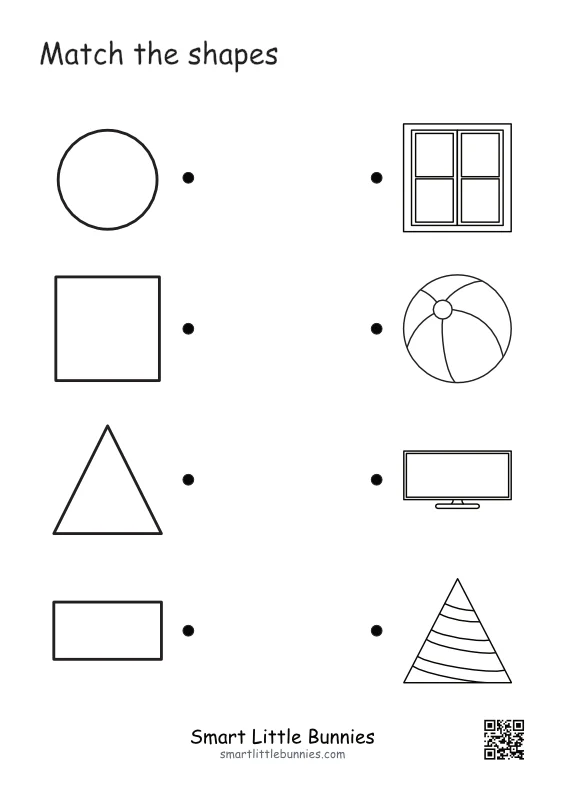
Circle, square, triangle, and rectangle, matched to a ball, window, party hat, and TV. The gentlest starting point, using the four shapes children meet first.
Download Worksheet 1 (A4) · US Letter
Worksheet 2 — Introducing the Oval
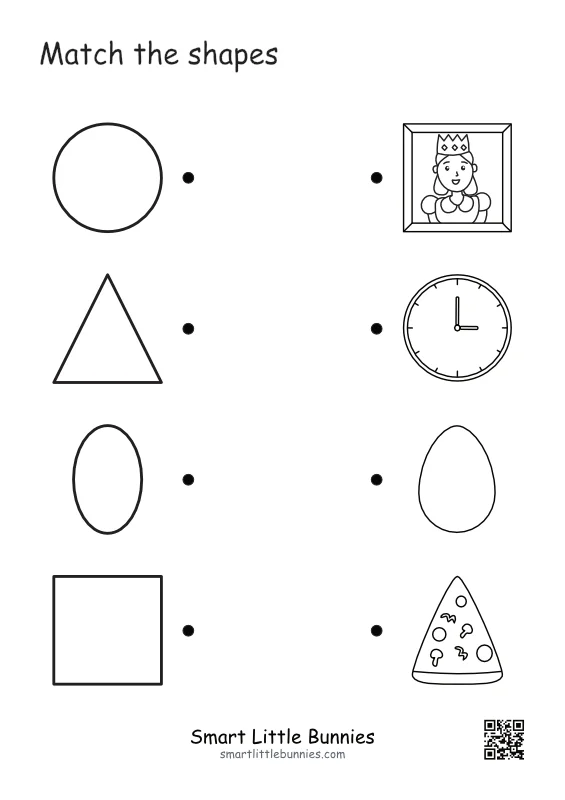
Circle, triangle, oval, and square, matched to a clock, a slice of pizza, an egg, and a picture frame. This sheet adds the oval and asks children to tell it apart from the circle, which is a useful early distinction.
Download Worksheet 2 (A4) · US Letter
Worksheet 3 — Round and Straight Together
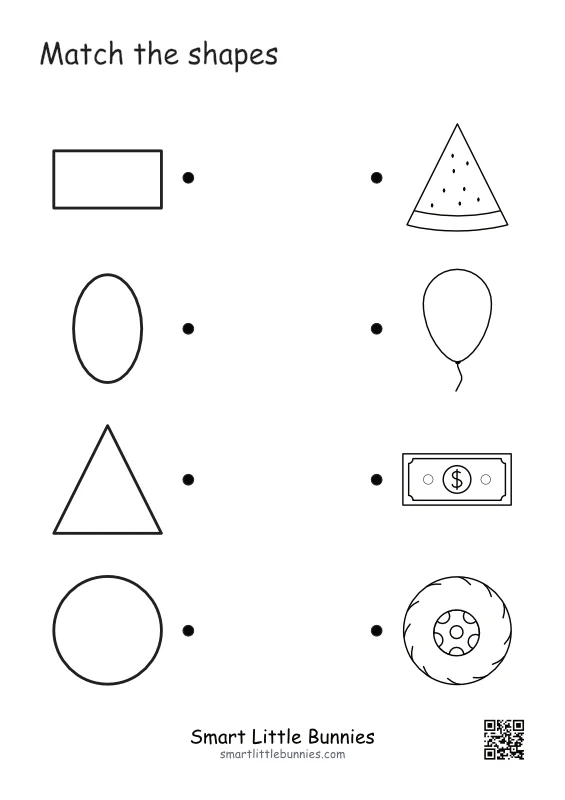
Rectangle, oval, triangle, and circle, matched to a cash note, a balloon, a slice of watermelon, and a tyre. Mixes round and straight-sided shapes so children have to look carefully at each object's outline.
Download Worksheet 3 (A4) · US Letter
Worksheet 4 — Trickier Shapes
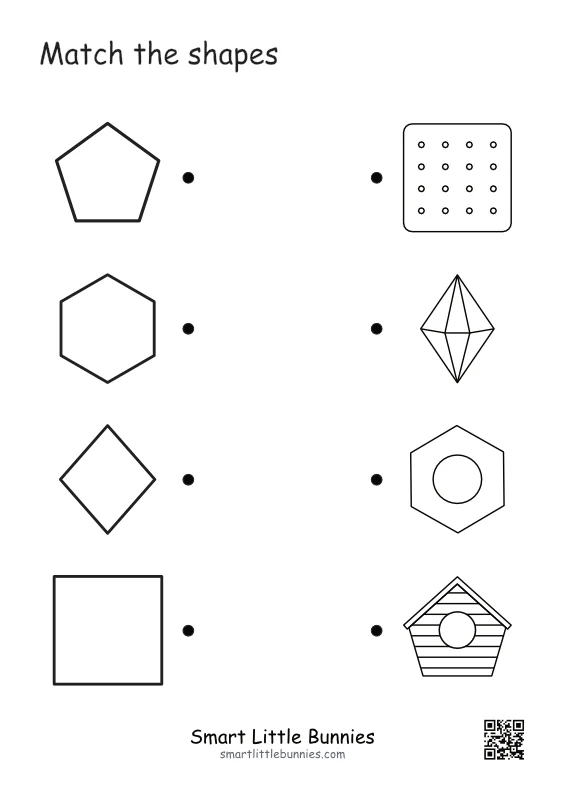
Pentagon, hexagon, diamond, and square, matched to a birdhouse, a nut, a diamond, and a biscuit. A step up, introducing many-sided shapes that children see less often, so counting sides becomes part of the task.
Download Worksheet 4 (A4) · US Letter
Worksheet 5 — Many-Sided Shapes
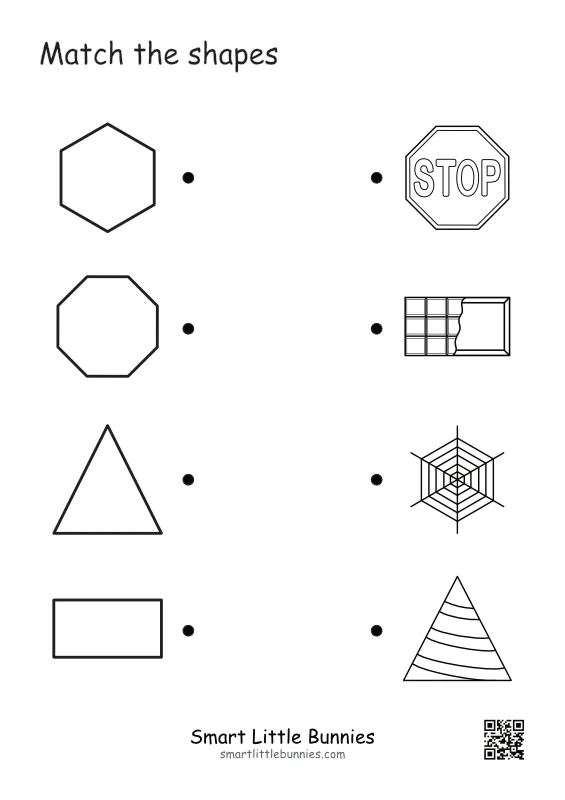
Hexagon, octagon, triangle, and rectangle, matched to a spider web, a stop sign, a party hat, and a bar of chocolate. The most advanced sheet, with the octagon and hexagon side by side so children practice counting sides to tell them apart.
Download Worksheet 5 (A4) · US Letter
What Children Build From This Set
- shape recognition across the basic forms
- visual scanning and matching
- early spatial reasoning, connecting symbols to real objects
- fine-motor control and hand-eye coordination through line drawing
- the vocabulary of shapes, said aloud and reinforced
A short, screen-free activity that works at home or in a classroom, and that quietly builds the geometry foundation children carry into later maths.